

Konstanz AI Study
There is a significant gap between the discourse surrounding artificial intelligence and the actual day-to-day experiences of employees. Based on data from over 1,100 representative working individuals in Germany, the third wave of the University of Konstanz’s AI study provides, for the first time, a clear picture of just how far this transformation has actually progressed.
Kaum ein Thema prägt die Diskussion über die Zukunft der Arbeit so stark wie Künstliche Intelligenz. Die Expectations are high, and the topic is being intensely debated in the public sphere. But what does the reality of everyday work look like? For the third wave of the Konstanz AI Study, we surveyed a representative sample of over 1,100 working people in Germany in May 2026—including returning participants from previous years alongside new ones. The results paint a nuanced picture: AI is making inroads into the workplace, but more slowly, informally, and unevenly than public discourse suggests. Employees often drive adoption themselves, while corporate policies, training, and leadership have yet to keep pace. AI is indeed transforming the world of work—but as a gradual, unevenly distributed process rather than an abrupt upheaval. This presents a challenge for leaders and organizations: to steer the informal, often unmanaged use of AI into organized, secure channels and ensure access for all employee groups.
AI adoption is growing only slowly and often informally.
Despite rapid technological advancement, the increase in everyday work practices remains moderate. Currently, 38 percent of employees use AI tools at work, up from 35 percent the previous year (see Figure 1). Consequently, there is no question of widespread adoption. More noteworthy than the growth rate is the nature of this dissemination: AI is often not introduced by the organization itself but is brought into the company by the employees. Only 55 percent of AI users state that their most frequently used tool was officially introduced by their employer. Many are thus gaining experience on their own initiative, while binding guidelines, secure infrastructures, and training opportunities are often still lacking. While this individual initiative is valuable, it also entails risks—such as concerns regarding data protection and the absence of systematic skill development within organizations.
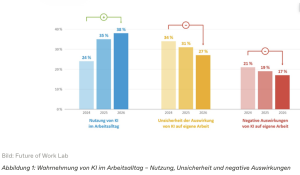
How many employees use AI in the workplace?
According to the third Constance AI Study, 38 percent of employees in Germany use AI tools at work. The figure was 35 percent the previous year. Adoption is thus growing more slowly than public discourse might suggest. Furthermore, for only 55 percent of AI users was the most frequently used tool officially introduced by their employer. A significant proportion of employees therefore use AI on their own initiative—and sometimes without binding company policies.
The risks and opportunities of AI remain, above all, a societal issue.
The discrepancy between societal and personal risk perception is striking. Four out of ten employees expect AI and automation to harm the labor market overall over the next ten years. In contrast, only 17 percent fear losing their own jobs. Uncertainty regarding the impact of AI on one’s own work is also gradually declining, though at 27 percent, it still affects more than one in four people.
Likewise, concrete changes remain barely visible so far. Only twelve percent perceive an AI-driven decline in entry-level positions, even though this is currently a subject of intense public debate. A mere 23 percent already see AI making a tangible contribution to their company’s value creation. Both the risks and the opportunities associated with the technology are currently perceived more strongly at the societal level than within one’s own professional or organizational reality.
AI usage gap between employee groups persists
The uneven development across different types of work is most evident when comparing fields of activity. In office and knowledge-based roles, nearly half of employees (49 percent) now use AI, whereas in production-related and manual jobs, only one in four does so (see Figure 2). While usage is increasing in both groups, the gap between them is not narrowing. The disparity is even more pronounced when looking at education levels: 56 percent of employees with a high level of education use AI, compared to 21 percent of those with a low level of education. Furthermore, highly educated employees are more likely to associate AI with positive expectations and speak openly about its use. In knowledge work, 51 percent communicate openly about it, compared to just 28 percent in production-related roles. This carries the risk that AI will exacerbate existing labor market inequalities rather than reduce them.
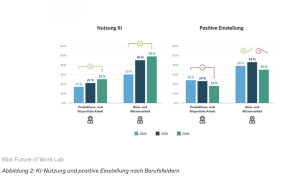
Which groups of employees use AI particularly frequently?
In Germany, AI is primarily used by office and knowledge workers and by individuals with higher levels of education. The usage rate stands at 49 percent for office and knowledge work, compared to 25 percent for production-related and manual roles. Among employees with a high level of education, 56 percent use AI, whereas the figure is 21 percent for those with a low level of education. These disparities demonstrate that access to AI and the professional opportunities it offers is currently unequally distributed.
Organizational support depends heavily on company size.
Whether employees receive guidance often depends on the size of the organization. In small organizations, only eleven percent report AI training, and ten percent mention mandatory usage guidelines. In large companies and corporations, these figures are two to three times higher. Consequently, small and medium-sized enterprises, in particular, run the risk of falling behind. One finding stands out for managers: even where training, guidelines, and internal AI tools are already in place, direct supervisors rarely actively address the topic of AI. Depending on the size of the organization, only 16 to 25 percent of employees view their supervisor as a regular point of contact for AI-related matters. This represents one of the greatest untapped opportunities.
What can leaders do about unequal AI usage?
Managers should regularly discuss the use of AI with their teams, establish clear guidelines, and offer all employee groups learning opportunities directly related to their work. Low-threshold formats are particularly important for individuals who have had little exposure to AI so far. Suitable areas of application exist beyond traditional knowledge work—for instance, in work planning, quality assurance, documentation, maintenance, or shift scheduling. In this way, AI can become a supportive tool for many employees rather than exacerbating existing disparities.
AI Transformation: Key Takeaways for Executives
The results make it clear that the AI transformation is less a technological challenge than a task for organizations and leaders. Five key areas of focus are crucial.
- Embrace employee initiative: Employees are already using AI, and leaders and organizations should channel this energy. Clear guardrails—defining which tools are permitted, what data must not be entered, and where human oversight remains necessary—create a sense of security and are a prerequisite for productive use.
- Making AI a leadership priority: The fact that leaders so rarely actively address AI serves as a wake-up call. Those who regularly discuss AI, share team experiences, foster an open learning culture, make existing knowledge visible, and identify risks early on play an active role in shaping this transformation. Today, skills are built less through one-off training sessions and more through continuous learning in day-to-day work.
- Creating access across all areas of work: To ensure AI does not drive new inequalities, leaders should specifically examine how employees outside the realm of traditional knowledge work can also benefit—for instance, in areas such as work planning, quality assurance, documentation, maintenance, or shift scheduling. AI should be viewed not merely as a tool for streamlining operations, but also as an instrument for support and professional development.
- Actively counteracting inequality: The usage gap based on job role and education level will not close on its own. Leaders should therefore specifically engage employees who have had limited exposure to AI so far—using accessible, work-integrated formats and sharing proven use cases within the team. In this way, AI becomes an opportunity for everyone rather than a privilege for the few.
- Systematically monitor impact: Since both opportunities and risks are not yet readily apparent in day-to-day operations, companies should monitor and evaluate the use of AI—using economic metrics as well as indicators of satisfaction and collaboration. This allows expectations to be compared with actual experiences.
About the study: Since 2024, the Konstanz AI Study—led by Prof. Dr. Florian Kunze (University of Konstanz, Future of Work Lab)—has been continuously examining how the use of artificial intelligence is evolving in the German workplace. The third wave of the survey (May 2026) is based on responses from 1,105 employed individuals. The study was funded by the DFG Cluster of Excellence “The Politics of Inequality.”
The authors:
Prof. Dr. Florian Kunze ist Inhaber des Lehrstuhls für Organizational Behavior und Leiter des Future of Work Lab an der Universität Konstanz sowie Principal Investigator am Exzellenzcluster “The Politics of Inequality”.
Carolina Opitz is a doctoral candidate at the Chair of Organizational Behavior at the University of Konstanz and conducts research at the Future of Work Lab on technological change processes in the world of work.
Elena Gerdiken is a doctoral candidate at the Chair of Organizational Behavior at the University of Konstanz and conducts research on digital stress in the workplace at the Future of Work Lab.
Source: haufe.de